
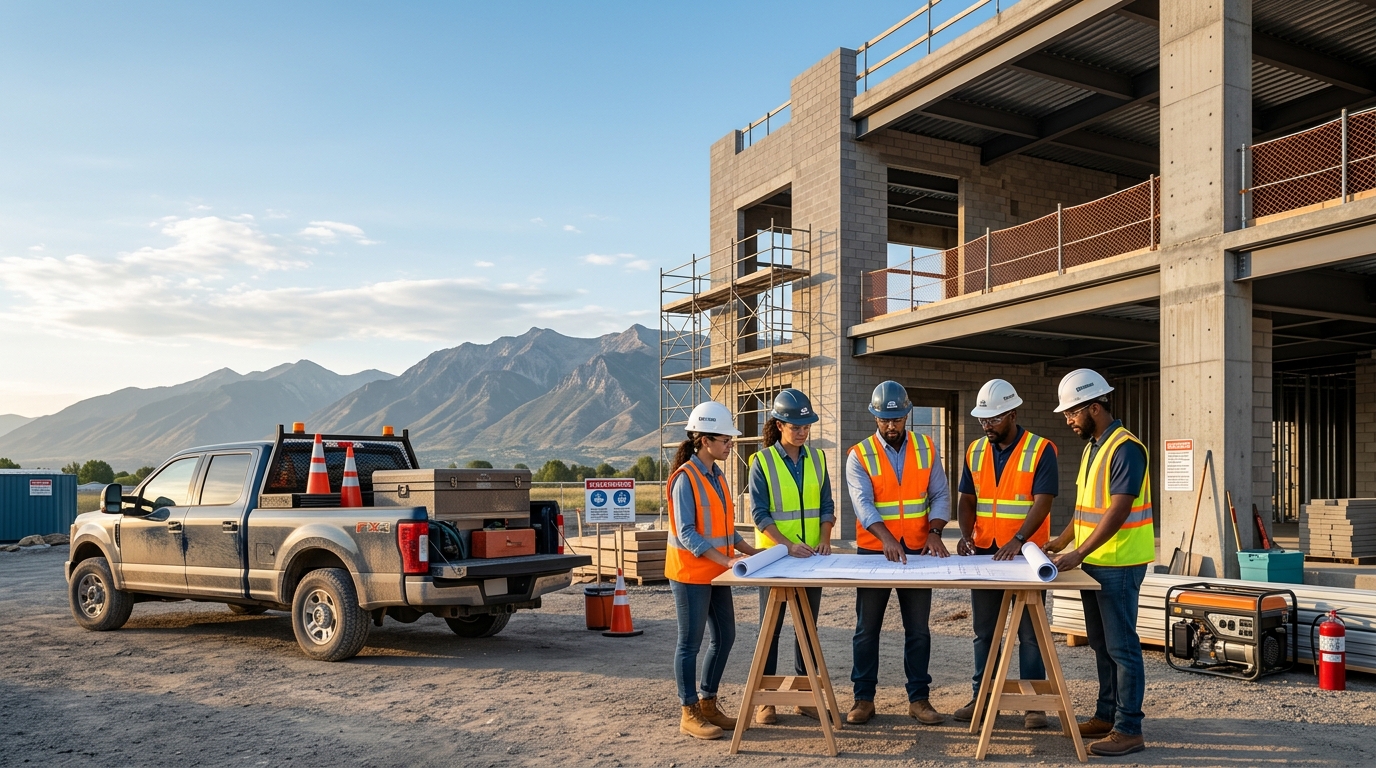
Utah's construction industry runs on contracts, and most of those contracts require specific insurance coverage and documentation before you can even start bidding. BTC Insurance Services builds dedicated construction insurance programs for Utah contractors, covering general liability, workers' compensation, commercial property, and commercial umbrella coverage, along with the certificates of insurance that general contractors, lenders, and property owners across Salt Lake, Utah, Davis, Weber, Washington, and Summit counties routinely require.
[Call 801-327-0117]
What Insurance Does a Utah Construction Company Need?
Most Utah construction companies need general liability insurance, workers' compensation, and commercial property or equipment coverage as a baseline, with commercial auto added for company vehicles and commercial umbrella coverage layered on top for contracts requiring higher liability limits than a standard policy carries. Which combination makes sense for your business depends on whether you are a general contractor managing subcontractors, a specialty trade working under other contractors, or a company that carries significant equipment and jobsite exposure. Our Construction Insurance page walks through how BTC Insurance Services builds this program specifically for Utah contractors.
Why Do Utah General Contractors Need Certificates of Insurance?
If you are bidding a job in Utah, the general contractor, lender, or property owner will very likely require a certificate of insurance proving you carry specific coverage and limits before you can start work. Many of these contracts also require primary and non-contributory wording, which affects how your policy responds relative to another party's policy in the event of a claim. Getting these details wrong, or waiting until the last minute to request a certificate, can hold up a bid you were otherwise ready to win. BTC Insurance Services prepares certificates of insurance and reviews contract-required wording as a standing part of every Utah construction account, not a special request.
Do Utah Subcontractors Need Their Own Insurance?
In most cases, yes. General contractors in Utah typically require subcontractors to carry their own general liability and workers' compensation coverage, both to protect the project and to avoid taking on liability for a subcontractor's work. If you are a Utah general contractor, documenting that your subcontractors carry adequate coverage is part of protecting your own business, and if you are a subcontractor, having your own coverage in place is often a prerequisite for getting hired at all. BTC Insurance Services helps Utah contractors on both sides of this relationship understand and document these requirements.
How Does Heavy Equipment Affect a Utah Contractor's Insurance Program?
Heavy equipment, whether owned or rented, carries its own exposure separate from your general liability and property coverage, and Utah's construction market includes plenty of excavation, grading, and heavy equipment work where this matters directly. Equipment coverage should account for how the equipment is used, whether it is scheduled specifically or covered under a blanket limit, and what happens if a piece of equipment is damaged or stolen mid-project. BTC Insurance Services reviews your specific equipment and how it is used as part of building your Utah construction program, rather than applying a generic equipment limit that may not match your actual fleet.
How Does Commercial Umbrella Coverage Fit Into a Utah Construction Program?
Jobsite injury claims can exceed the limits of a standard general liability or workers' compensation policy, and Utah contracts increasingly require higher liability limits than a base policy carries on its own. Commercial umbrella insurance adds additional liability limits above your existing general liability, commercial auto, and workers' compensation policies, which lets a Utah contractor meet a higher contract-required limit without rebuilding their entire program. Our Commercial Umbrella Insurance page covers how this coverage works in more detail.
How Can a Utah Construction Company Get a Quote Quickly Before a Bid Deadline?
Call 801-327-0117 directly rather than waiting on an online form if a bid deadline is close. BTC Insurance Services works with Utah contractors regularly on tight timelines, and having your current declarations page, a copy of the contract requiring specific coverage, and your subcontractor list ready speeds up the process considerably.
How Does Commercial Auto Insurance Fit Into a Utah Construction Program?
Most Utah construction companies operate at least one company vehicle, whether it is a single truck or a small fleet used to move crews and equipment between jobsites. Commercial auto insurance covers those vehicles specifically, since a personal auto policy typically excludes business use, and hired or non-owned auto coverage can be added to close a gap for employees using their own vehicles for jobsite work. BTC Insurance Services builds this coverage alongside your general liability and workers' compensation as part of one construction program, not a separate policy handled elsewhere.
What Role Does Claims History Play in Utah Construction Insurance Cost?
A Utah contractor's claims history, particularly jobsite injury and property damage claims, has a direct effect on both workers' compensation and general liability pricing. Consistent safety practices and accurate job classifications tend to keep this history favorable over time, which shows up as lower premiums at renewal. If your business has had claims in recent years, that history does not rule out competitive pricing, but your producer needs the full picture to place coverage accurately.
How Should a Utah Contractor Prepare Before Switching Insurance Agencies?
Bring your current policy, your certificate of insurance history, and any recent audit results to your new agency before your current policy expires, so your new program can be built around an accurate picture of your business. This matters even more in construction than in many other industries, since a gap in certificate documentation, even briefly, can hold up a bid or an active project. BTC Insurance Services reviews this history directly when a Utah contractor switches agencies.
What Questions Should a Utah Contractor Ask Before Hiring an Insurance Agency?
Ask whether the agency has real experience with contractors specifically, not general small business clients. Ask how quickly they can turn around a certificate of insurance when a bid deadline is close, whether you will work with the same producer and account manager over time, and whether they review your subcontractors' coverage as part of your program. BTC Insurance Services builds its Utah construction relationships around direct, specific answers to exactly these questions.
How Does Property and Equipment Coverage Work for a Utah Contractor?
Commercial property coverage for a Utah contractor typically extends to owned equipment, tools, and materials, but how it applies can depend on whether equipment is scheduled specifically or covered under a blanket limit, and whether it is owned, leased, or rented. This matters more in construction than in many industries, since equipment moves between jobsites and carries real exposure to theft and damage while it is there. BTC Insurance Services reviews your specific equipment and how it is used when building this part of your program, rather than applying a generic limit that may not reflect your actual fleet.
What Does a Typical Utah Construction Insurance Program Cost?
Cost varies significantly based on your trade, payroll, claims history, and the specific coverage lines and limits your contracts require, so there is no single figure that applies across Utah's construction industry. A small specialty subcontractor with a light equipment list will see a very different quote than a general contractor managing several subcontractors and a fleet of vehicles. BTC Insurance Services builds your quote around your specific operations, rather than a generic construction industry average, which is the only way to get a number you can actually rely on when bidding work.
How Does Cyber Liability Apply to a Utah Construction Company?
Construction companies handle more sensitive data than many business owners realize, from project bids and contracts to subcontractor payment information and client financial details, all of which can be exposed in a data breach or business email compromise. Cyber liability coverage addresses breach notification costs, business interruption, and third-party liability tied to that kind of incident, and general liability policies typically exclude these claims entirely. It is not a coverage line every Utah contractor thinks to ask about, but it is worth a direct conversation, particularly for a construction company managing bids and payments digitally.
What Should a Utah Contractor Expect During the Application and Underwriting Process?
Expect to answer specific questions about your revenue, payroll, subcontractor use, safety practices, and claims history, since these are exactly the factors that determine your final program and pricing. Underwriters may also ask about the types of projects you typically take on and any specialty work, like excavation or heavy equipment operation, that carries its own risk profile. BTC Insurance Services walks Utah contractors through this process directly, explaining what is being asked and why, rather than treating underwriting as a black box you simply wait on.
[Call 801-327-0117]
Frequently Asked Questions
What insurance does a Utah general contractor need? Most Utah general contractors need general liability, workers' compensation, and commercial property or equipment coverage at minimum, often with commercial umbrella coverage added for contracts requiring higher liability limits.
Do Utah subcontractors need their own insurance? In most cases, yes. General contractors typically require subcontractors to carry their own general liability and workers' compensation coverage before they can work on a project.
How fast can BTC Insurance Services provide a certificate of insurance for a Utah bid? Certificates are a standard part of every construction account, and calling 801-327-0117 directly, rather than using a general online form, is the fastest way to handle a tight bid deadline.
What does primary and non-contributory wording mean on a Utah construction contract? It is endorsement language that affects how your policy responds relative to another party's policy when both could apply to the same claim. Many Utah general contractors and property owners require this wording specifically before you can bid.
Does a Utah construction company need cyber liability insurance? It is worth considering, since general liability policies typically exclude data breach claims, and construction companies handle sensitive bid, contract, and payment information that can be exposed in an incident.
How long does it take to set up a construction insurance program in Utah? It depends on how quickly you can provide details about your operations, payroll, and any contract requirements, but a straightforward Utah construction account can often be quoted and bound in a matter of days once BTC Insurance Services has what it needs.
Does a Utah contractor need a separate policy for rented or leased equipment? Not necessarily a separate policy, but rented or leased equipment often needs to be addressed specifically within your commercial property or equipment coverage, since ownership status can affect how a loss is handled. BTC Insurance Services reviews owned, leased, and rented equipment together when building your program.
Talk to a Utah Construction Insurance Agency Before Your Next Bid
If a certificate, a limit, or a subcontractor requirement is holding up a bid, let's get ahead of it together.
[Call 801-327-0117]
