
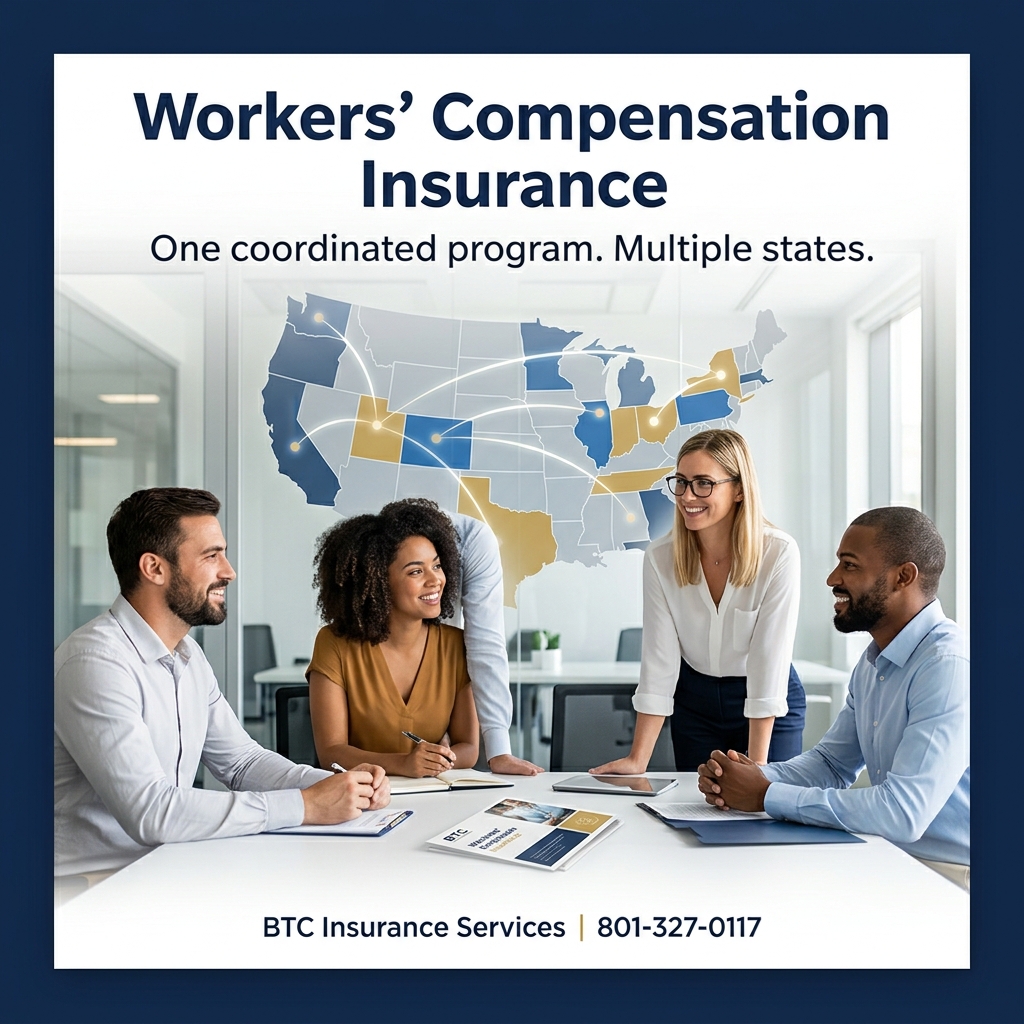
If your business has employees working in more than one state, your workers' compensation program needs to account for each state's specific requirements, not just the state where your business is headquartered. BTC Insurance Services is licensed to place commercial coverage, including workers' compensation, for businesses in nearly 40 states nationwide, and the question we hear most from multi-state employers is not whether they need coverage, but how to manage it consistently across every state they operate in without ending up with a patchwork of disconnected policies.
[Call 801-327-0117]
Why Do Workers' Compensation Requirements Vary by State?
Workers' compensation is regulated at the state level in the United States, which means coverage requirements, employee classification systems, and even how premiums are calculated can differ from one state to the next. A business operating in several states cannot assume that meeting one state's requirements automatically satisfies another's. This is one of the more common gaps we see when a growing business expands into a new state without updating its workers' compensation program to match.
What Should a Multi-State Employer Look for in a Workers' Compensation Program?
Look for an agency that can place and manage coverage across every state you operate in under one coordinated program, rather than requiring a separate policy and a separate point of contact in each state. Ask specifically whether your producer and account manager will oversee the full program across all your states, or whether you will be routed to a different person or office depending on where a question originates. BTC Insurance Services builds one workers' compensation program across a client's full multi-state footprint, with the same producer and account manager managing it from state to state.
How Does Payroll Reporting Work Across Multiple States?
Payroll and job classifications generally need to be reported and audited on a state-by-state basis, since each state applies its own classification codes and rate structures. A business with employees in three states may see three different classification outcomes for what looks like the same job, depending on how each state defines that role. BTC Insurance Services reviews classifications state by state as part of building your program, rather than applying one state's classification system across your entire operation.
What Happens When an Employee Works in More Than One State?
This is one of the more genuinely complicated questions in multi-state workers' compensation, and the right answer can depend on where the employee is based, where the injury would occur, and the specific states involved. Rather than guess at how this applies to your business, this is exactly the kind of situation to review directly with your producer before an actual claim forces the question. BTC Insurance Services works through these scenarios with multi-state clients as part of building their program, not after an issue comes up.
How Does Experience Modification Work for a Multi-State Employer?
Experience modification, the adjustment to your premium based on your claims history, can be calculated differently depending on how your states and carriers structure your program. A fragmented program across multiple carriers can sometimes prevent your good claims experience in one state from benefiting your rates in another. BTC Insurance Services builds workers' compensation programs with this in mind, so a multi-state employer's overall claims record works in their favor as intended.
How Can a Multi-State Business Get a Workers' Compensation Quote?
Call 801-327-0117 or request a quote online, and a BTC Insurance Services producer will review every state your business operates in, along with your current coverage and claims history, before building your program. If you are consolidating multiple state-specific policies into one program, bring your current declarations pages from each state so your producer can see your full picture at once.
What Is Experience Modification for a Multi-State Program?
Experience modification is a factor applied to your workers' compensation premium based on your claims history relative to other businesses in your classification. For a multi-state employer, how this factor is calculated and applied can depend on how your program is structured across states and carriers, which is part of why a fragmented, state-by-state approach can sometimes prevent a strong overall claims record from benefiting your rates the way it should. BTC Insurance Services builds multi-state programs with this in mind.
How Does Workers' Compensation Differ From General Liability for a Multi-State Employer?
Workers' compensation and general liability cover different situations, and a multi-state employer needs both in every state where it has meaningful exposure. Workers' compensation covers your own employees for job-related injuries, regardless of fault, while general liability covers third-party claims, like a customer or visitor injury, tied to your business operations. Confusing the two, or assuming one covers what the other is meant for, is a common gap we see when reviewing a growing multi-state employer's existing program.
What Records Should a Multi-State Employer Keep?
Accurate, current payroll and job classification records for every state you operate in make both your premiums and any audits more predictable. When your business adds employees in a new state, or changes the type of work being done in an existing one, updating your classifications as those changes happen, rather than waiting until renewal, helps avoid a surprise adjustment down the line. Our Premium Audit Resources page covers documentation practices in more detail.
How Does Switching Agencies Work for a Multi-State Workers' Compensation Program?
Switching agencies does not require a coverage lapse if it is timed correctly, even across multiple states. Bring your current policies, audit history, and experience modification records from every state to your new agency before your current coverage expires, so your new program is built around an accurate picture of your full operation rather than starting from scratch in each state. BTC Insurance Services reviews this history directly when onboarding a multi-state client switching from another agency.
How Does Job Classification Affect Workers' Compensation Cost?
Every job your employees perform is assigned a classification code reflecting the risk associated with that work, and that classification is one of the biggest single factors in your premium in every state you operate. Two businesses with similar payroll can see very different costs if their employees are classified differently, whether because the work is genuinely more demanding or because a classification does not actually match the job. BTC Insurance Services reviews your employees' actual work against their classification codes in each state, rather than accepting classifications carried over from a previous policy.
Which Industries Typically See the Highest Workers' Compensation Costs?
Industries with more physical, jobsite-based work, particularly construction and roofing, generally see higher workers' compensation costs than office-based industries like professional services or technology, simply because the injury risk is higher. Manufacturing and real estate can also carry meaningful exposure depending on the specific operations involved. A higher-risk industry can still get competitive pricing, but the starting point reflects real risk rather than an arbitrary number, which is part of why accurate classification and safety practices matter even more for a multi-state employer managing this across several states at once.
What Should a Multi-State Employer Do Immediately After a Workplace Injury?
Getting the injured employee appropriate medical attention comes first, followed by documenting what happened while the details are fresh, including which state the injury occurred in, since that can affect which state's requirements apply. Reporting the injury to your insurance agency promptly, rather than waiting to see how serious it turns out to be, keeps the claims process moving in the correct state and avoids complications from a delayed report. BTC Insurance Services' account managers are a direct point of contact across every state in your program, not a general claims hotline that has to look up which state's rules apply.
How Does Workers' Compensation Interact With Other Coverage a Multi-State Business Carries?
Workers' compensation does not exist in isolation from the rest of your program. General liability responds to third-party claims rather than employee injuries, commercial umbrella coverage can extend liability limits above your workers' compensation employer's liability portion if a claim exceeds it, and management liability may come into play if an injury claim also raises an employment practices issue. This gets more complicated across multiple states, since each state's underlying limits and requirements differ. BTC Insurance Services builds workers' compensation as one coordinated part of your overall multi-state program, so these coverage lines work together in every state rather than leaving a gap where two policies each assume the other applies.
[Call 801-327-0117]
Frequently Asked Questions
Do workers' compensation requirements vary by state? Yes. Workers' compensation is regulated at the state level, so requirements, classification systems, and premium calculations can differ meaningfully from one state to the next.
Can one agency handle workers' compensation for a business in multiple states? Yes, as long as that agency is licensed in every state you operate in. BTC Insurance Services is licensed in nearly 40 states and builds one coordinated program rather than separate state-by-state policies.
What happens if my business expands into a new state without updating our workers' compensation coverage? This can create a real coverage gap, since a new state's requirements are not automatically satisfied by your existing policy. Review your program with your producer whenever your business expands into a new state.
How do I get a workers' compensation quote for a multi-state business? Call 801-327-0117 or request a quote online. A BTC Insurance Services producer will review every state you operate in before building your program.
What should I do first if an employee is injured while working in a different state than usual? Get the employee appropriate medical attention, document which state the injury occurred in, and report it to your insurance agency promptly so the correct state's process applies from the start.
Can a multi-state employer be sued even with workers' compensation insurance in place? Workers' compensation generally limits an employee's ability to sue their employer directly over a workplace injury, in exchange for guaranteed medical and wage coverage regardless of fault, though the specifics can vary by state. This is part of why keeping coverage current in every state you operate protects the business as much as the employee.
Does workers' compensation cover independent contractors across the states we operate in? Generally, no, since workers' compensation is designed to cover employees rather than independent contractors, though how a worker is classified can vary by state. This classification is worth confirming state by state with your producer, particularly for a multi-state employer that may classify similar roles differently across locations.
Talk to a Nationwide Workers' Compensation Insurance Agency
Wherever your employees currently work, we would like to help you build one coordinated program around all of them.
[Call 801-327-0117]
